


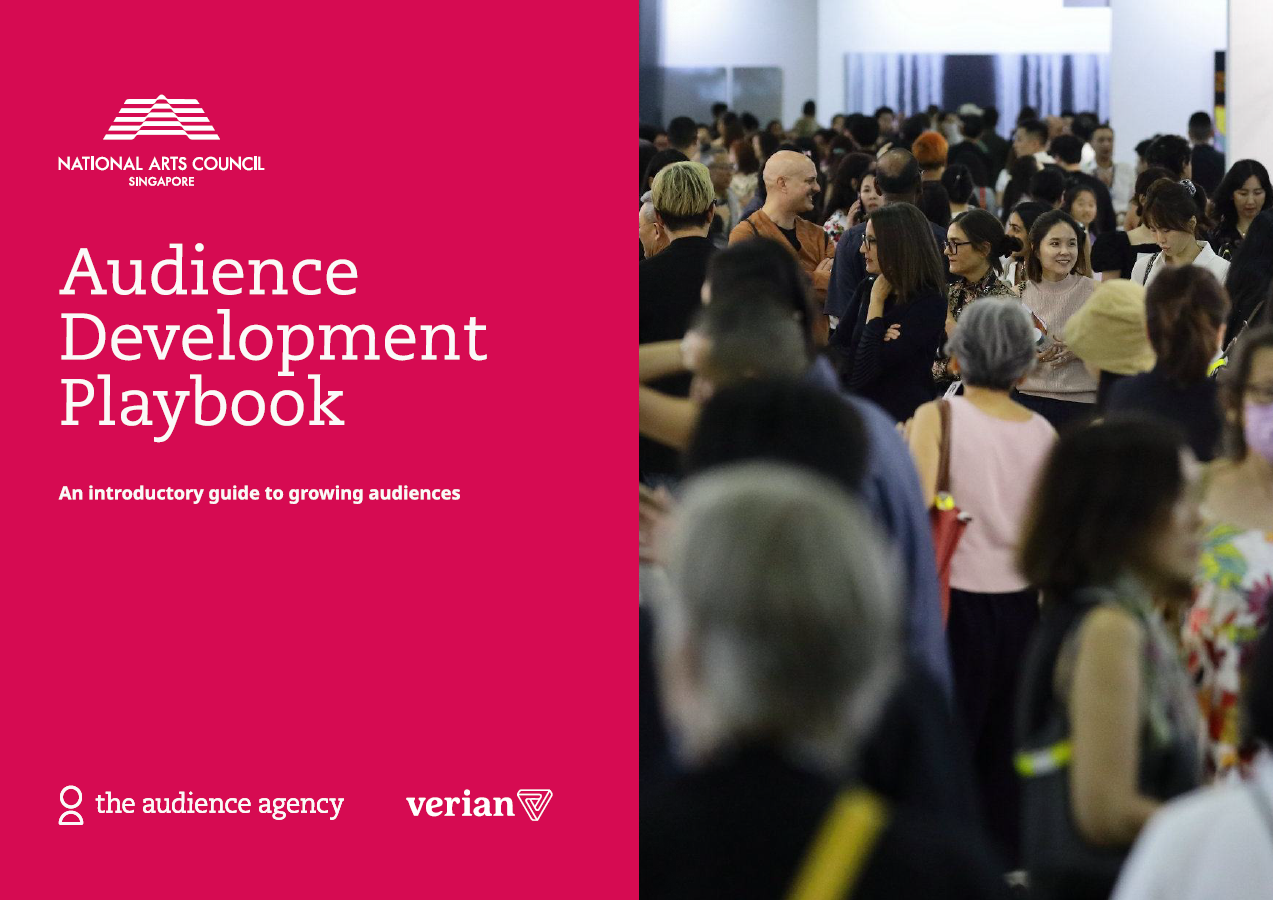
NAC and Industry Partners, developed Practical Framework built on
insights from over 3,000 respondents
SINGAPORE, 16 January 2026 – The National Arts Council (NAC), in collaboration with key arts industry partners, announced the launch of the Audience Development Playbook today. Developed as a response to the arts industry’s call for a shared understanding and common language of evolving consumer behaviours, the Playbook translates and distills complex data into audience insights, including their interests, attitudes and behaviours, and equips arts practitioners with practical tools and case studies to better target, develop and grow audiences in Singapore. This landmark resource provides arts practitioners with a practical, data-driven framework designed to deepen audience engagement efforts and grow audience numbers sustainably across Singapore’s diverse arts landscape.
A Collaborative, Data-Driven Approach
The Audience Development Playbook is the result of an extensive two-year process, starting in 2024 involving:
- In-depth interviews: Consultations with over 20 arts industry leaders
- Public survey: Data gathered from more than 3,000 members of the public
- Industry workshops: Feedback from over 100 artists, partners and students from the arts community to test the practical application of the planning guides.
Low Eng Teong, Chief Executive Officer, NAC, said, “Audiences are at the heart of what we do. The Audience Development Playbook is designed to empower arts practitioners, offering data, insights and practical tools to deepen connections with the people they create for.”
What the Audience Development Playbook Offers
From 5 life stages to 12 distinct personas
As a starting point, the Playbook provides arts practitioners with a common language and understanding of what audience development means. From here, the Playbook moves beyond traditional demographics such as the five life stages to introduce 12 distinct personas based on these stages from the public survey. These personas give more colour and deepen arts practitioners’ understanding of audiences based on their interests (e.g. artforms and genres), attitudes (e.g. motivations and lifestyle preferences) and behaviours (e.g. willingness to pay).
Refer to Annex A on details of the 12 distinct personas.
Aggregated Audience Data
In addition to granular data on the 12 personas based on the five life stages, the Playbook also offers aggregated audience data including their interests and willingness to pay. Findings include:
- Value over Cost: Charging a small fee may not significantly deter arts attendance; in fact, for some personas like “Culture Seekers” (parents with older children), a fee can even increase perceived quality and attendance.
- ‘Gateway’ Genres: Music and Heritage remain the most relatable genres across all audiences. They serve as effective ‘gateways’ to introduce passive audiences to more niche artforms, especially through multi-disciplinary experiences.
Practical Guides
The Playbook includes step-by-step guides and templates for practitioners to use when planning audience development efforts. These tools and resources support the following:
- Understanding the organisation and audiences: Practitioners can explore what audiences their organisation or project targets, identifying both current and potential audiences.
- Setting priorities and target segments: From there, practitioners can define and prioritise audience personas to create tailored offerings aligned with their audience development goals.
- Testing and adapting: Practitioners can prototype and test operational plans to identify areas for review before the final programme roll-out.
- Putting plans into action: Finally, practitioners can implement their programmes and evaluate the impact of their audience strategies in the longer run.
Case Studies
For inspiration and in the spirit of peer learning and sharing, the Playbook also contains local and international case studies as a growing repository. For now, some case studies include:
- The TENG Company: Launched as Singapore's first immersive lie-down wellness concert, “五行 Wuxing, The Five Elements”, targeting wellness-focused individuals who might not typically engage with traditional Chinese music. The results demonstrated effective audience development: 59% of attendees were first-time participants, while 41% were returning, reflecting both successful outreach and strong loyalty. Additionally, 72% expressed interest in attending future events, indicating strong re-engagement potential.
- StoryFest Singapore: Produced by the Storytelling Centre, StoryFest Singapore expanded beyond its traditional, family-focused indoor programming to engage new segments such as young adults (15 years old and above), heritage tourism enthusiasts, and visual arts audiences. The festival introduced an outdoor, roving storytelling experience along the Singapore River, held in the evenings to appeal to working adults. The results exceeded expectations: tickets sold out in the first year, and 96% of tickets were sold in the second year despite a 50% price increase from $10 to $15. Notably, 88% of attendees were first-time participants with overall attendance improving from 79% to 95%, with few no-shows.
Looking Ahead: Implementation and Workshops
The Audience Development Playbook is an evolving resource. Following the launch, NAC will:
- Integrate Learnings: Application of the Audience Development Playbook data and tools to signature platforms such as the Singapore International Festival of Arts, Singapore Writers Festival, and Singapore Art Week.
- Conduct Capacity Building: A series of workshops will be held in March 2026 to help arts practitioners better understand audience data and adopt development frameworks in the Audience Development Playbook. NAC is gauging interest from the arts community for the workshops following the industry launch. Registration details will be shared at a later date.
- Digital Integration: Practitioners are encouraged to leverage platforms like Catch.sg and the SG Culture Pass to amplify their audience outreach.
Given the evolving needs of audiences, the Playbook will be updated with more case studies as audience development grows. As a long-term process which spans programming, marketing, capability development to funding, education and partnerships, NAC and the arts sector will also incorporate learnings from ongoing initiatives to refine the Playbook’s insights and build a growing repository of strong case studies for Singapore’s arts sector.
Information about the Audience Development Playbook can be found on NAC’s website at https://go.gov.sg/nac-ad.
-End-
High resolution images may be found in this Digital Media Kit.
Annex A: About the 12 Personas
Annex B: Profiles for Interviews
For media enquiries, kindly contact:
Jocelyn Loong Assistant Director Strategic Communications National Arts Council +65 9114 8611 | Charlotte Chew Assistant Manager Strategic Communications National Arts Council +65 9351 0910 |
About National Arts Council
The National Arts Council (NAC) is a statutory board under the Ministry of Culture, Community, and Youth that champions the arts in Singapore. The Council promotes artistic excellence by providing diverse opportunities for artists and arts organisations while expanding access for audiences to appreciate the impact of the arts in enriching lives. By working closely with the arts community and partners, the Council seeks to build a connected society, creative economy and distinctive city through the arts. For more information, visit www.nac.gov.sg.