National Arts Council-Arts Education Programme
This scheme enables arts providers to offer quality arts education programmes that engage students across schools and institutions.
Last updated on 26 September 2026
Open Call for the 2026-2028 NAC-AEP Directory has closed.
The open call for the NAC-AEP 2026 cycle was conducted from 21 April 2025 to 23 May 2025. The next open call will be conducted in 2028.
We will not be accepting any proposals for this cycle. Arts providers can approach schools directly to pitch your programme.
National Arts Council-Arts Education Programme (NAC-AEP)
The National Arts Council-Arts Education Programme (NAC-AEP) provides students with quality arts education experiences. Since 1993, it has grown to reach 95% of MOE schools, which consistently affirm its importance in supporting students’ arts learning experiences.
Desired outcomes
NAC-AEP aspires towards the following outcomes by the time students complete secondary school education:
Every student will have attended a performance or exhibition in a professional arts venue.
Every student will have had a learning experience with a local artist or arts group.
Every student will have been exposed to arts programmes across all 6 art forms.
Be part of the NAC-AEP programme
Arts educators are key partners of NAC-AEP that provides all students with access to quality arts education programmes. Schools can utilise the Tote Board Arts Grant to subsidise the purchase of any programme listed in the NAC-AEP Directory (opens in new tab), Public Arts Programmes as well as the Artist-in-School Scheme (AISS).
Key features of the NAC-AEP 2026 cycle
The NAC-AEP 2026 Cycle places focus on providing quality programmes guided by the NAC Arts Education Framework and informed by MOE curriculum goals and holistic development outcomes as well as provide greater programme customisation that would cater to the diverse interests and needs of students.
Intentional design of programmes
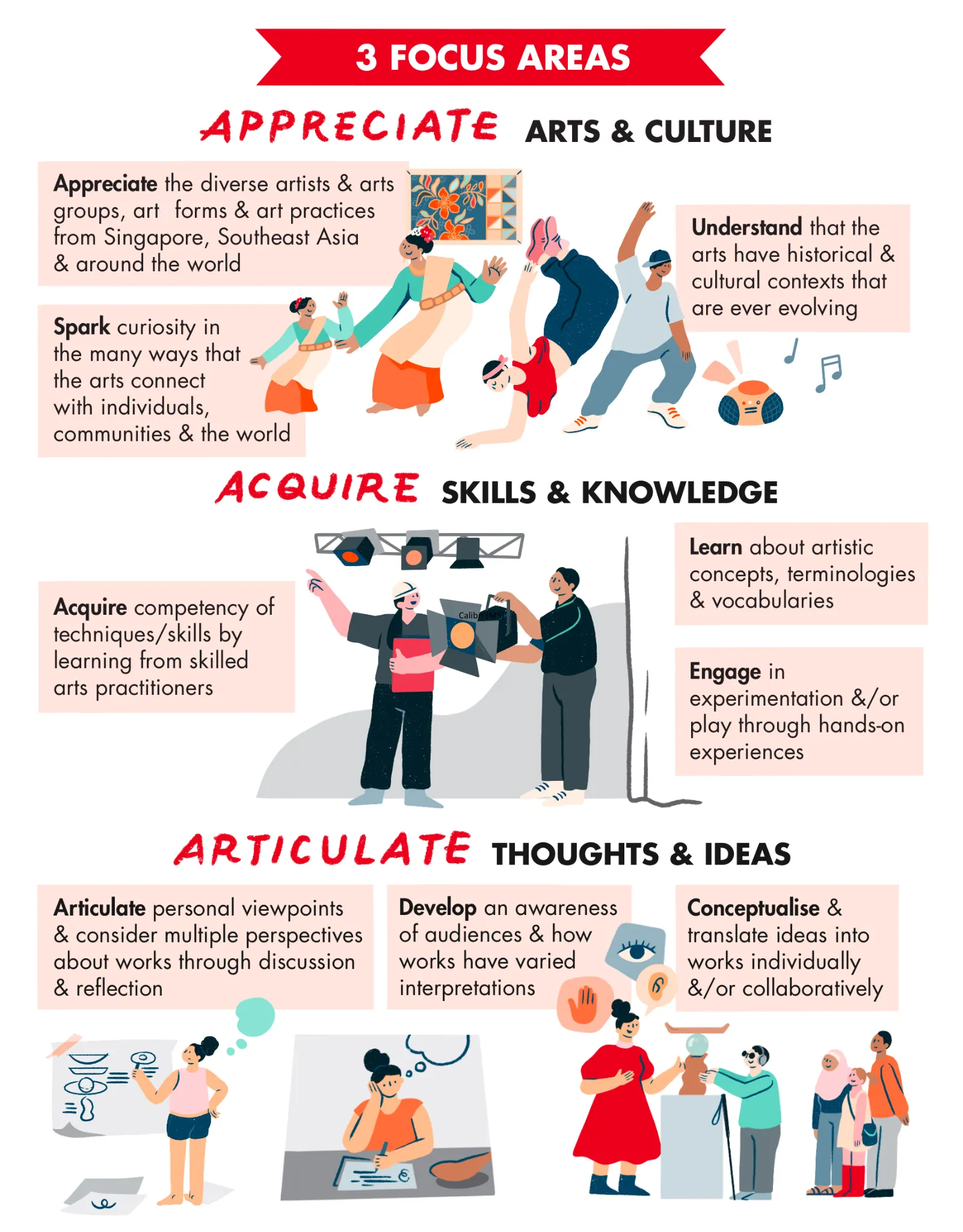
Programme design for NAC-AEP 2026 cycle are guided by the learning outcomes articulated in NAC Arts Education Framework, consisting of 3 Focus Areas and 5 Points of Emphasis.
It is important for arts educators to be familiar with the Framework to guide intentional design and delivery of arts programmes, define learning outcomes and scope key concepts and/or skills for lesson plans. For more information about NAC Arts Education Framework, please read the NAC AEP 2026 - Programme Design Guide. [DOCX, 2.05 MB] (opens in new tab).
Programme design for NAC-AEP 2026 cycle foreground active learning where students are engaged in hands-on, hearts-on and/or minds-on arts learning experiences facilitated by the arts educators. Given the increasingly diverse needs and interests of students, arts educators need to be aware of students’ readiness and their learning profiles and be prepared with differentiated activities and resources so that all students can maximise their arts learning experience.
Wider range of arts learning experiences
To cater to the wide range of learning modes and student profiles, the scheme supports a variety of programme formats (physical, digital and blended) and programmes types (performance, excursion, talk and workshop).
More opportunities for customisation
To foster closer collaboration with teachers, Programme Providers can offer optional add-on components to extend students’ engagement and learning in/ through the arts.
Priority areas for Preschools and SPED schools
Preschool education
Arts education in the early years plays a fundamental role in children's creative expression and contributes significantly to their overall development, particularly in areas of communication skills and social-emotional competencies. Through intentionally designed programmes, young children develop fundamental capabilities that serve as building blocks for their future learning and appreciation of the arts.
MCCY’s 2025 Committee of Supply announced a commitment to scale up NAC-AEP to all government-supported preschools so as to widen access to quality arts experiences to young learners, fostering creativity and expression through the arts from an early age.
Participating Preschool Centres
For 2026, NAC has partnered the following Anchor Operators (AOP) and Partner Operators (POP) for selected centres to receive funding to purchase Preschool AEP.
Get the comprehensive listing of Preschool AEP 2026 Centres (opens in new tab)
Preschool Provider requirements
Arts practitioners delivering programmes in preschools must comply with prevailing ECDA requirements, including the required medical examination.
Special Education
Arts education plays a critical role in enabling students with Special Educational Needs (SEN) to acquire skills in communication, creativity, critical thinking, and collaboration. Through engagement in the arts, students with SEN learn how to express their individuality, connect with their peers in meaningful ways, and develop self-confidence.
The roll out of the MOE Visual Arts Teaching and Learning Syllabus for Special Education (SPED) schools from 2021 underscores how arts programmes intentionally designed for students with special educational needs can support students’ holistic development.
Engaging schools as an Arts Provider
Beyond NAC’s outreach efforts with MOE and schools, programme providers are required to actively engage schools to raise awareness of their programmes and/or to share more information about their mission and art form.
NAC-AEP 2026-2028 Cycle Reference Documents for Applicants
User Guide for Applications and User Guide Video [DOCX, 2.30 MB] (opens in new tab) and User Guide Video (opens in new tab)
Potential Instructor(s) List and School Engagement Plan [DOCX, 1020.13 KB] (opens in new tab)
Terms and Conditions for Applicants [DOCX, 42.77 KB] (opens in new tab)
Other Reference Documents [For New Applicants Only]
Becoming an arts instructor
What we look for in Arts Educators
Quality arts education depends on educators with the knowledge and competencies to engage and inspire students. Programme providers are responsible for ensuring their arts educators have the relevant expertise and experience to deliver programmes effectively in schools.
Requirements vary by programme mode:
Performance — Professional qualification (minimum diploma) in a relevant art form and industry experience
Talk and Excursion — At least 2 years of teaching experience in local schools in the relevant art form and student profile
Workshop — Pedagogical training or arts-based teaching qualifications, or a minimum of 10 years of teaching experience in local schools
Full details are in the assessment criteria [DOCX, 1015.89 KB] (opens in new tab)).
Recognised qualifications
Artists with any of the following qualifications would be considered to have met the pedagogical training criterion:
Diploma / Degree / Masters / PhD in Education or teaching;
Formal Arts-based training directly relevant to teaching and learning (e.g. LASALLE MA in Arts Pedagogy and Practice, Trinity Guildhall Teaching Diploma etc).
Extensive track record in teaching their specialised field of art (min. 10 years of teaching experience in local schools)
NAC-AEP 2026 - 2028 Cycle Reference Documents for Approved Programmes
Providers with approved programmes will need to inform the instructors they are working with to register on the NAC-AEP portal and submit their CVs for NAC's assessment.
Providers can subsequently tag the relevant approved instructors to their approved programmes. Approved aprogrammes will not be published on the directory if instructor tagging is not completed.
a) User Guide for Instructor Registration [DOCX, 1.81 MB] (opens in new tab)
b) Sample Instructor Registration Form [DOCX, 542.10 KB] (opens in new tab)
c) User Guide for Instructor Tagging [DOCX, 2.48 MB] (opens in new tab)
d) Terms and Conditions - Instructor Portfolio [PDF, 138.65 KB] (opens in new tab)
e) Terms and Conditions for Approved Programmes [DOCX, 53.48 KB] (opens in new tab)
We're here to help
Drop us an email if you have more queries.