Community arts: Toolkits and case studies
The arts have the power to bring people together, improve wellbeing, and strengthen communities. But turning that vision into reality takes more than creativity — it takes the right tools.
Last updated on 26 September 2026
Find the right tools for your community arts project
Whether you are planning a community arts initiative or evaluating the outcomes of an existing one, you will find practical frameworks, validated tools, and real-world case studies to support your work.
Explore these resources and find what works for you:
Arts and Health Evaluation Toolkit (2025)
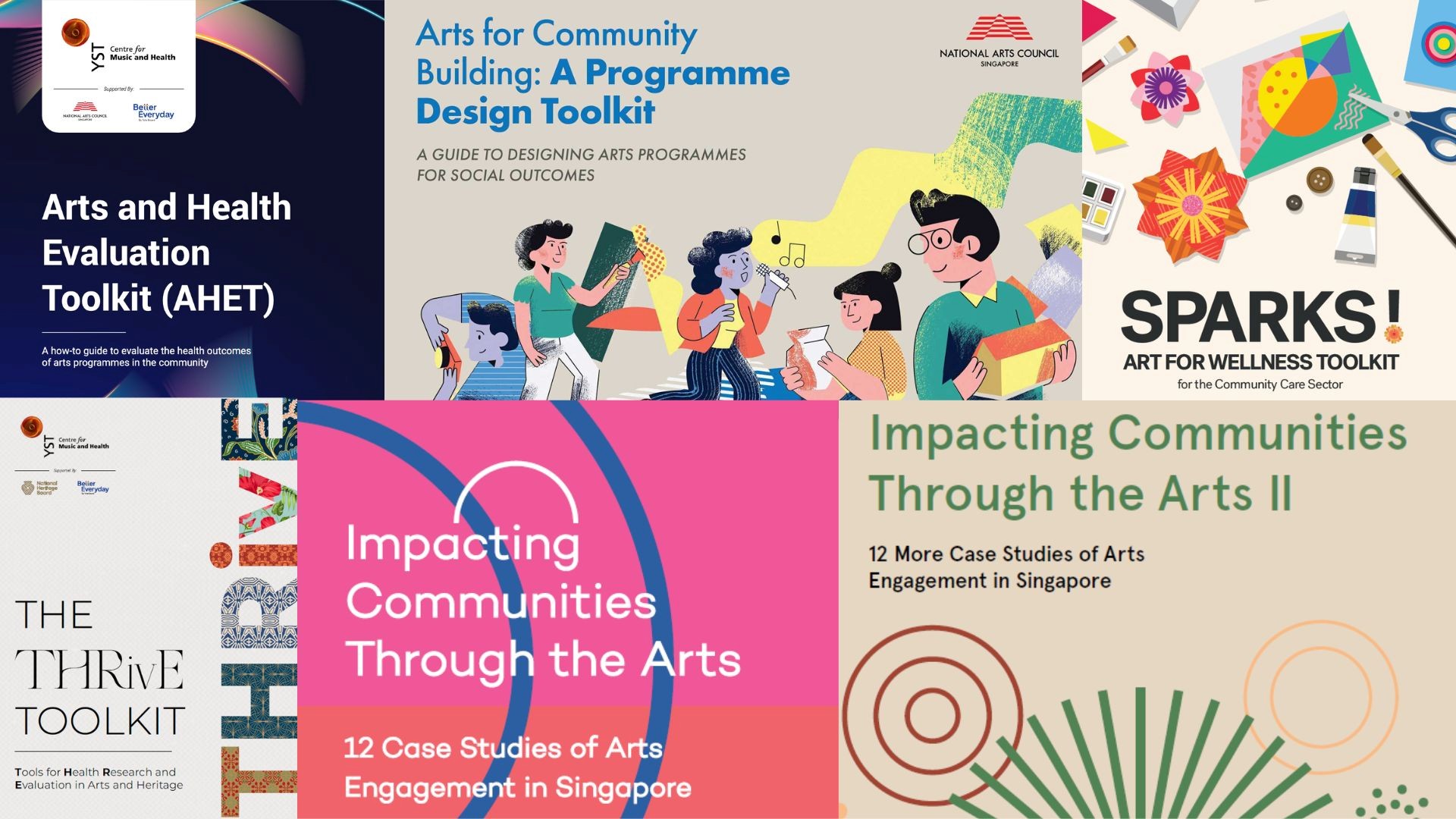
Developed by the Centre for Music and Health and supported by the National Arts Council Research Grant, the Arts and Health Evaluation Toolkit (AHET) is a practical guide for arts practitioners and community organisations to evaluate the impact of arts programmes on health and wellbeing. Focusing primarily on quantitative methods, it offers guidance on clarifying evaluation goals, selecting feasible study designs, and using validated tools to measure outcomes such as mental health, wellbeing, social connection, and physical health. AHET is designed to make evaluation more approachable, especially for practitioners working outside academic settings, enabling them to demonstrate the impact of arts engagement with credibility and confidence.
The THRivE Toolkit: Tools for Health Research and Evaluation in arts and heritage
Building on AHET, The THRivE Toolkit (Tools for Health Research and Evaluation in arts and heritage) offers a broader, more comprehensive approach to evaluating the effects of arts and heritage initiatives on health and wellbeing. It incorporates both quantitative and qualitative methods, and extends the scope of evaluation from AHET to include emotional responses, mood regulation, and social cohesion. Designed for arts and heritage practitioners, researchers, and organisations, The THRivE Toolkit offers guidance on data analysis, reporting, and dissemination, and includes best-practice recommendations, use cases, and local case studies. Through promoting consistent and high-quality evaluation practices, The THRrivE Toolkit aims to strengthen the evidence base for arts and heritage interventions.
Visit the Centre for Music and Health website (opens in new tab) to access the toolkits
Arts for Community Building: A Programme Design Toolkit (2024)
Developed by the National Arts Council, the Arts for Community Building: A Programme Design Toolkit is a resource relevant to programme organisers, producers, and artists who are keen to bring people closer together through the arts.
This resource offers a framework for programme design, alongside useful case studies and practical tips, with the objective of equipping readers with tools to develop an arts programme for building a community.
Download the Design Tools found in the toolkit. (opens in new tab)
Download the Evaluation Tools found in the toolkit. (opens in new tab)
Watch how it works
Watch this video to learn more about how Larry Yeung, Executive Director, Participate in Design, used the toolkit to design a community arts programme titled Better 2gather, that brought residents of Telok Blangah together to bond and form meaningful relationships.

SPARKS! Art for Wellness Toolkit (2018)
The SPARKS! Art for Wellness Toolkit is a collection of creative activities developed as a joint initiative by the Agency for Integrated Care (AIC) and NAC. The activities in this toolkit are designed for frail seniors and can be simplified or adapted to offer a meaningful challenge.
Download the toolkit (opens in new tab).
Explore more case studies.
Impacting Communities Through the Arts: Case Studies of Arts Engagement in Singapore (Vol. 1 and 2)
The Impacting Communities Through the Arts series captures the good practices of community arts projects across Singapore. Volume 1 (2018) features 12 case studies showcasing how artists and arts projects have engaged communities and made a meaningful difference in people's lives. Volume 2 (2019) builds on this with another 12 case studies, highlighting work with a diverse range of communities — from seniors with dementia to residents of various neighbourhoods.
Together, both volumes offer inspiring ideas and approaches for artists, community organisations, place-owners, and policymakers.